From Pipeline to Capacity: Building a Connected Demand Forecast
Translate likely opportunities into dated skill requirements without treating every possible deal as a confirmed assignment.
Read article →Executive guide · CLOUSYS OPERATIONS LIBRARY
A services operating model that leaders can actually use.
For CEOs, COOs and transformation leaders evaluating how sales, people, delivery and finance should work together.

WHY THIS MATTERS
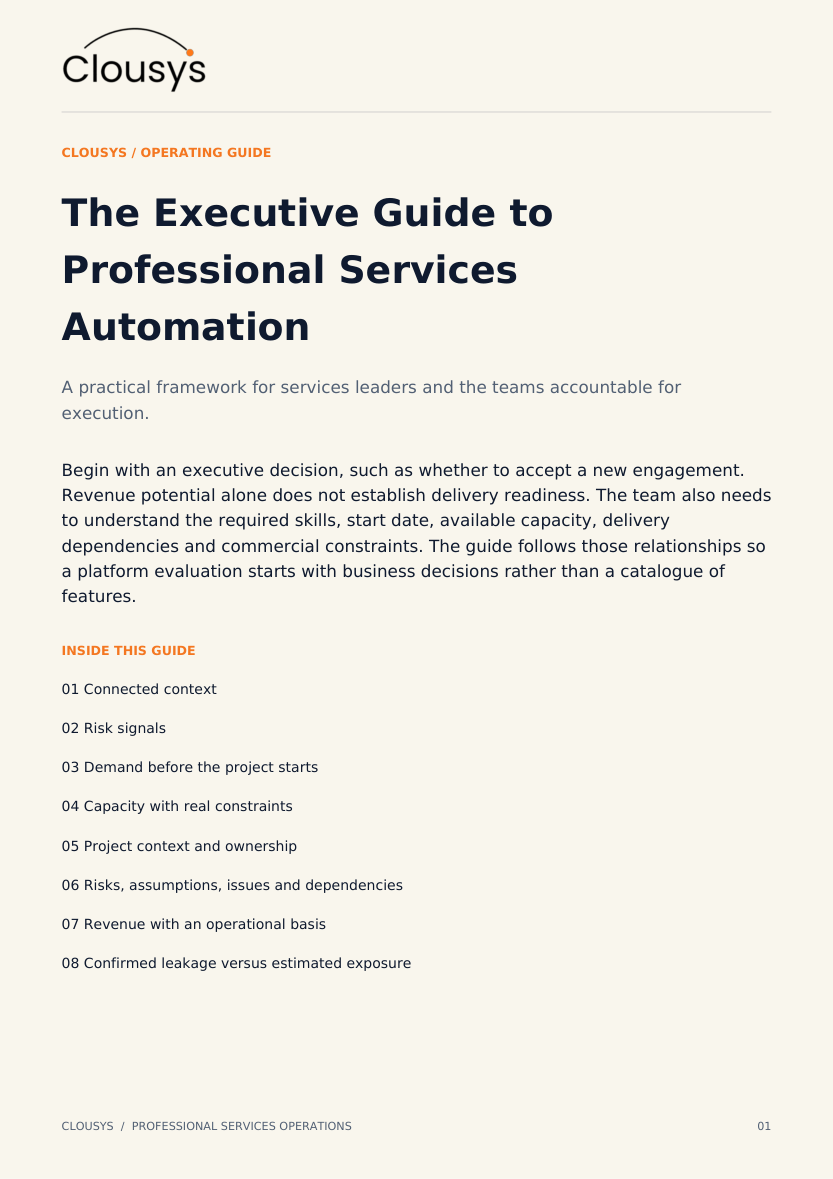
Begin with an executive decision, such as whether to accept a new engagement. Revenue potential alone does not establish delivery readiness. The team also needs to understand the required skills, start date, available capacity, delivery dependencies and commercial constraints. The guide follows those relationships so a platform evaluation starts with business decisions rather than a catalogue of features.
CHAPTER 1
Start with the relationships between opportunity demand, skills, assignments, projects and financial outcomes. An isolated data point rarely explains a services decision. The useful context is the chain showing how a change in one team’s plan affects the others.
CHAPTER 2
Use operational signals to focus attention on potential delivery, capacity and revenue issues. Distinguish observed facts from forecasts and make uncertainty visible. Teams need to understand why a warning matters before they can decide how to respond.
CHAPTER 3
Translate upcoming work into dated resource requirements. Capture the skill, effort, duration and confidence of each need. A likely opportunity and a signed project should remain distinguishable so planners can model scenarios without double-booking people against uncertain demand.
CHAPTER 4
Available capacity is not simply headcount. Subtract existing assignments, leave, working patterns and internal commitments from the planning horizon. Compare supply with dated demand by skill and role, and inspect upcoming releases before deciding that a gap requires a new hire.
CHAPTER 5
Give every project a clear scope, accountable manager and delivery structure. Keep the team aligned on the work being delivered and the commitments behind it. Project context connects scheduling and execution decisions to the client outcome instead of leaving the plan as an isolated task list.
CHAPTER 6
Capture RAID items with an owner, impact and next review. Distinguish a potential risk from an issue already affecting delivery. Escalations should connect the operational cause to the milestone, capacity or commercial consequence, making the required decision clear.
CHAPTER 7
Build the forecast from work that can realistically be staffed and delivered. Keep opportunity assumptions, committed work and billing expectations distinguishable. When a date or allocation changes, review the downstream revenue effect instead of updating the finance forecast independently of delivery.
CHAPTER 8
Keep confirmed blocked revenue separate from modelled exposure. Confirmed amounts should be traceable to transactions; estimates depend on explicit assumptions. Adding both into one total can mislead decision-makers and obscure whether an intervention is resolving an existing blockage or preventing a possible one.
TEAM WORKSHOP
Choose one upcoming engagement. Ask sales to describe the demand, resource management to show dated availability, delivery to identify the first milestone and finance to explain the billing conditions. Record where a team must re-enter information or rebuild context. Those handoffs are useful starting points for your implementation scope.
Agree the review cadence before expanding the scope. Use the same definitions each time and note changes to assumptions. Progress should be visible in the evidence behind the decision, not only in the appearance of a new dashboard.
TAKE THE GUIDE WITH YOU
The PDF contains the framework, chapter notes and working-session prompts shown here. Share it with the teams who own the handoffs so everyone can prepare using the same questions.
Your details are not submitted to a mailing list by this download form.
A consulting firm wins a six-week engagement requiring two analysts and one architect. Sales sees a start date in three weeks; the resource team sees an architect committed elsewhere for four weeks. Finance sees a fixed fee with limited contingency. A signed deal therefore creates a decision, not an automatically executable plan. The team can phase discovery, change the start date or source a qualified alternative. Record the cost and client impact of each option before the executive sponsor approves it.
A 12-person team has 480 contracted hours in a week. Approved leave removes 40 hours, leaving 440 available hours under this definition. With 330 approved billable hours, utilization is 330 / 440 = 75%. Using contracted hours instead gives 68.75%. Both calculations can be mathematically correct; switching denominators silently makes the management conclusion unreliable. Agree the definition before setting a target.
Choose one business unit and one decision to improve. Map the opportunity, resource requirement, assignment, time entry and invoice references. Identify where IDs or owners are missing. Baseline a small set of measures using the existing process; do not infer improvement from a new dashboard alone.
Use live work with named owners. Review exceptions twice a week and record which changes actually resolved them. Compare reports with source transactions. Include cancellations, leave changes, revised rates and invoice exceptions in the pilot, since happy-path testing conceals operational gaps.
Evaluate adoption, data completeness and exception ageing alongside financial outcomes. Decide which controls are stable enough to reuse. Retain a change log of definitions and integrations, train the next group with real examples, and confirm support ownership before expanding.
Includes the operating model, worked example, decision tables, implementation cadence and a reusable workshop worksheet.

Translate likely opportunities into dated skill requirements without treating every possible deal as a confirmed assignment.
Read article →
Review scope changes, excess effort, staffing mix, rate exceptions, idle capacity, late records and billing delays together.
Read article →
Give leaders a traceable view of capacity, delivery and financial risk, with clear distinctions between facts and estimates.
Read article →
Evaluate a resource recommendation against experience, delivery context and the constraints a skills score cannot explain.
Read article →