

Request a Demo

CLOUSYS · CONNECTED PROFESSIONAL SERVICES

Clousys on Salesforce

Scope a connected services operating model around your Salesforce environment.
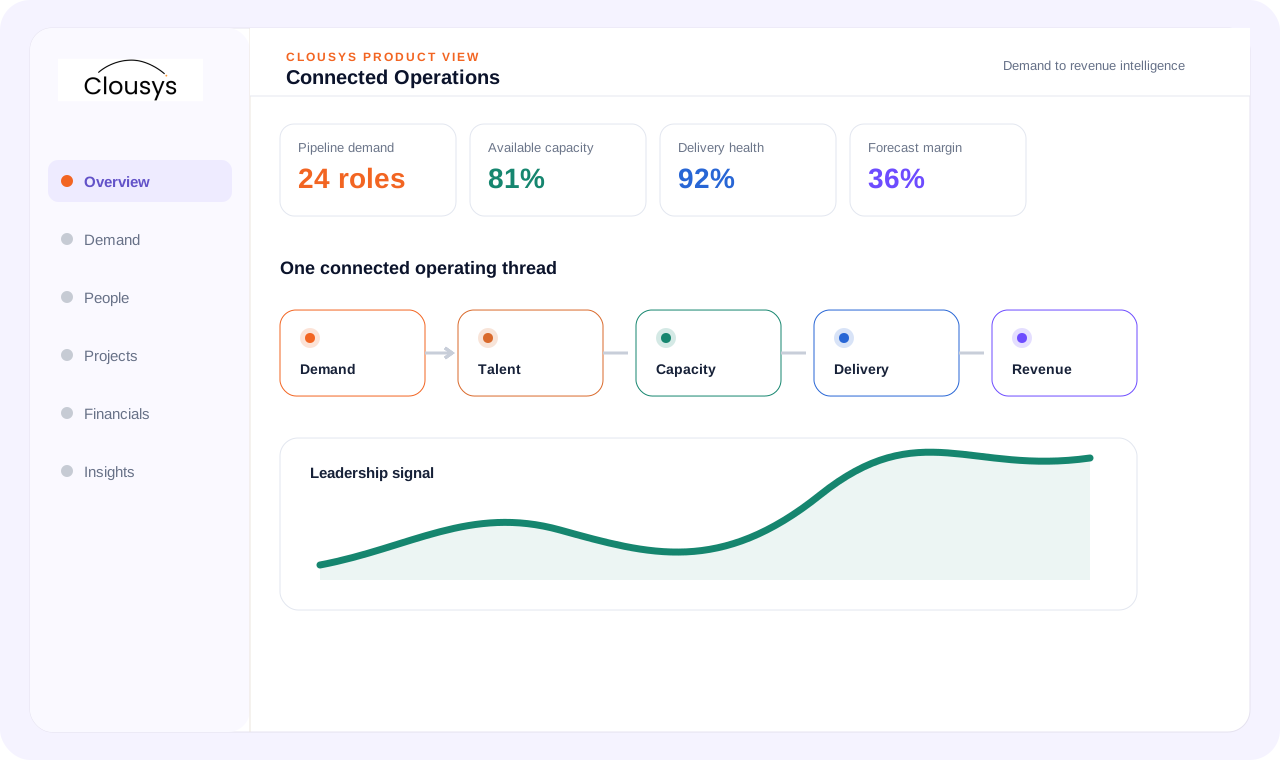
Integrations and API interface illustration
Illustrative product view · sample data, not a performance claim

THE DECISION THIS SUPPORTS

Evaluate the platform against the way your teams operate.

Review where customer, opportunity and services data should meet. Confirm the Salesforce context, integration scope and operating responsibilities for your implementation.

System ownership

Identify the authoritative source for people, clients, opportunities, projects and financial records.

Agree ownership before connecting data. A clear source-of-truth map prevents two systems from overwriting the same record with conflicting versions.

  • Source system
  • Record owner
  • Update direction

CRM and pipeline

Connect opportunity context to demand planning.

Preserve the relationship between forecast roles, expected dates and the commercial opportunity. Resource leaders can then distinguish probable work from confirmed requirements as the pipeline develops.

  • Opportunity context
  • Demand dates
  • Confidence

HR and workforce data

Align employee identifiers, role information and availability with the existing people systems.

Agree which fields are needed by resource planners and which must remain restricted. Reconcile the employee lifecycle so joining, changes and departures are reflected appropriately.

  • Employee identifiers
  • Field scope
  • Lifecycle events
CLOUSYS / OPERATING WORKFLOW

HR and workforce data

  1. 01
    Customer contextAccount and opportunity records
  2. 02
    Services operationPeople, delivery and finance
  3. 03
    Shared governanceReview ownership and implementation scope

Illustrative workflow · confirm configuration during your demo

Finance and invoicing

Map the boundary between delivery readiness and financial processing.

Clarify which system owns invoice creation, posting and downstream status. Retain identifiers across the handoff so exceptions can be investigated without manually matching unrelated records.

  • Invoice identifiers
  • Handoff status
  • Exception traceability

Collaboration tools

Design notifications around decisions people need to take.

Avoid broadcasting every record update into a team channel. Agree which milestones, approvals or exceptions deserve a notification and where the recipient should go to review the full evidence.

  • Relevant event
  • Recipient
  • Action destination

Mapping and validation

Document field mappings, required values and validation rules.

Test missing identifiers, duplicate records and changed dates before rollout. A successful connection means the receiving workflow can use the data correctly, not simply that an API request returned successfully.

  • Field mappings
  • Validation
  • Duplicate handling
CLOUSYS / OPERATING WORKFLOW

Mapping and validation

  1. 01
    Customer contextAccount and opportunity records
  2. 02
    Services operationPeople, delivery and finance
  3. 03
    Shared governanceReview ownership and implementation scope

Illustrative workflow · confirm configuration during your demo

Failure and reconciliation

Plan how failed transfers are detected, investigated and retried.

Make the responsible team and reconciliation process explicit. Review how updates behave during outages and how operations can recover without duplicating transactions or losing the change history.

  • Failure ownership
  • Retry approach
  • Reconciliation

Integration scope

Confirm connector availability, authentication, update frequency and data volumes during solution design.

The ecosystem view is a starting point for scoping, not a promise that every system is connected out of the box. Evaluate each required integration against the actual deployment.

  • Connector assessment
  • Authentication
  • Deployment scope

PRACTICAL QUESTIONS

Questions about clousys on salesforce.

What does a Salesforce foundation mean for the operating model?

It gives teams a common platform context for connected services records and workflows. Your solution design should identify how Clousys fits the Salesforce environment, permissions and data ownership already in place.

Do we need to replace every existing system?

No. Start by identifying workflows to consolidate and systems to retain. Payroll, finance or other established tools may remain part of the operating model through agreed integrations.

What should we confirm before rollout?

Review licensing, user groups, permissions, source data and integration dependencies. Confirm these against the actual deployment scope rather than assuming every capability is included in every configuration.

Discuss your requirements ↗
THE LATEST FROM CLOUSYS

Ideas for your next operating decision.

View all insights →